


26 November 2026
Beyond production
Earlier this month, we explored why location could help shape net zero and highlighted the importance of understanding where low-carbon gases are being produced and injected into the network.
Understanding where green gases are generated is one part of the story, but demonstrating and verifying their environmental value is another. Recent developments have brought that challenge into sharper focus.
The extension of the Green Gas Support Scheme (GGSS) to 2030 has provided greater certainty for biomethane developers, while NESO's latest analysis continues to point towards a growing role for low-carbon gases alongside electrification.
Taken together, these developments suggest the conversation is beginning to evolve. As low-carbon gas markets grow, attention naturally starts to shift from how much green gas can be produced to how its environmental value is demonstrated, reported and recognised.
Why certification matters
Once green gas (biomethane) enters the national network, it mixes with the wider gas supply, making it impossible to physically track renewable molecules to a specific home or business. To solve this, schemes such as the Green Gas Certification Scheme (GGCS) issue Renewable Gas Guarantees of Origin (RGGOs). These digital certificates provide a recognised way to prove that renewable gas has been produced, injected into the grid, and accurately reported across the market.
The rapid growth of the GGCS shows just how important reliable tracking has become for renewable energy. According to the 2025 Annual Report, the scheme supported 130 renewable gas plants across the UK that feed green gas directly into the national grid.
Xoserve data shows that more than 5.7 terawatt-hours (TWh) of biomethane was physically injected into the Great Britain gas network during 2024–25. Alongside this, 4.2 TWh of green gas certificates (roughly three-quarters of that physical volume) were formally claimed and locked in through the GGCS during 2025.
Whenever an individual customer, a business, or a group on a shared green tariff buys this gas, their certificates are permanently "retired" or "cancelled" in the central registry. This ensures the green gas cannot be double-counted and gives buyers verified proof that their energy is genuinely renewable.
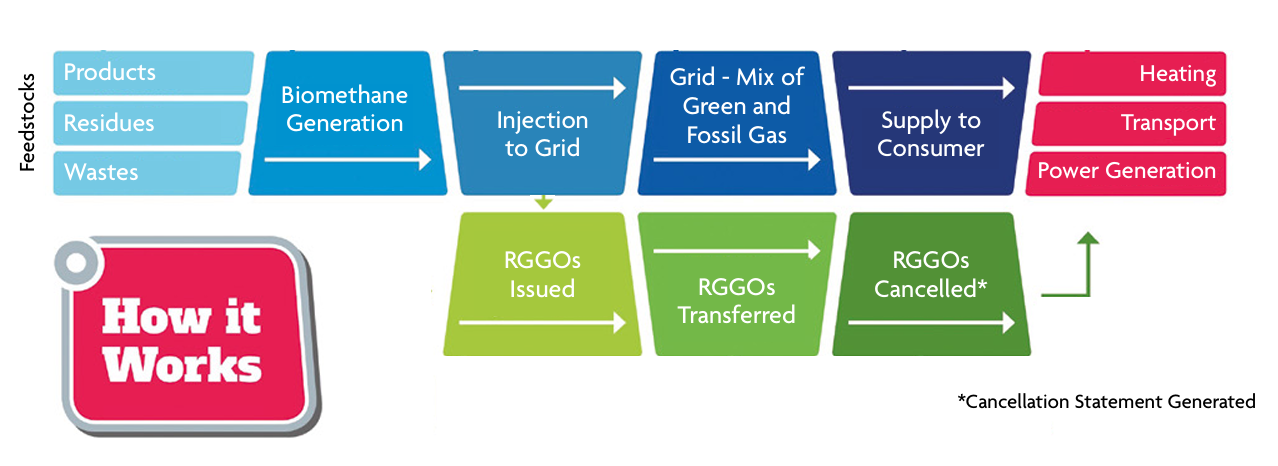
fig.1 - How Renewable Gas Guarantees of Origin (RGGOs) allow the environmental attributes of biomethane to be tracked and reported after gas enters the wider network.
Source: GGCS Annual Report 2025.
The next stage of market development
Learning from mature markets
In our article, How to Accelerate Biomethane Adoption in the UK: Lessons from our European Neighbours, we explored the conditions that have helped biomethane markets grow across Europe.
One theme that runs through many of these more established markets is the importance of the frameworks that sit behind deployment.
Across Europe, organisations such as the European Renewable Gas Registry (ERGaR) support the recognition and transfer of renewable gas certificates between participating markets, helping create a common framework for tracking environmental attributes across national borders.
In 2025 alone, a record 4.27 TWh of certificates were transferred through ERGaR's cross-border scheme, a 52% increase on the previous year, demonstrating growing demand for consistent approaches to renewable gas certification and reporting across Europe.[RB3.1]
Why does ETS alignment matter?
On this note, recent confirmation of the link between the UK and EU Emissions Trading Schemes (ETS), which will become operational from January 1st, 2028, have highlighted the growing importance of robust carbon accounting frameworks. This will mean ETS allowances issued in either the UK or EU can be used for compliance purposes across either scheme. While the agreement does not currently allow emissions reductions from grid-injected biomethane to be claimed, it recognises that a suitable system would be required to account for renewable gas and prevent double counting before this could occur.
This reinforces the importance of certification and trusted market data. As low-carbon gas markets continue to develop, the ability to demonstrate where renewable gas has been produced, injected and accounted for is likely to become increasingly important.
The role of data
Behind every certificate sits a rigorous data-sharing process. In the UK, the GGCS works with Xoserve, the central data service provider for Britain's gas market, to verify that the volume of green gas claimed matches the physical gas entering the pipes. Under their formal data-sharing agreement, Xoserve supplies verified biomethane injection data directly to the GGCS, underpinning the certification process and ensuring environmental claims are accurate.
As the UK continues to increase biomethane production and explore future opportunities for low-carbon hydrogen, certification and trusted market data will play an increasingly important role in supporting transparency, reporting and the wider development of low-carbon gas markets.
Looking Ahead
While biomethane certification is relatively established through frameworks such as the GGCS, the next challenge for low-carbon gas markets is ensuring environmental value can be recognised consistently across different technologies, markets and regulatory frameworks.
This is already becoming evident in hydrogen. As hydrogen projects move closer to deployment, greater attention is being placed on how "low carbon" can be demonstrated and evidenced in practice. The UK's Low Carbon Hydrogen Standard provides a framework for assessing the emissions associated with hydrogen production, helping create a more consistent basis for comparing projects and supporting future market development.
Producing green gas is only part of the challenge. For low-carbon gas markets to scale, environmental value must also be capable of being measured, evidenced and trusted.
Get in touch
Learn more about Xoserve and the role we play in decarbonisation, in our dedicated Decarbonisation Knowledge Centre.
If you have any feedback or questions on any of the above, please email us at decarbonisation@xoserve.com.
Share this news article